
Embroidery Business Profit Margin: A Complete Guide to Maximize Profits
The embroidery business profit margin shows how much money is left after covering costs such as machines, threads, and labor. Most embroidery shops earn between 20% and 60%, while some niche products like patches or baby clothes reach 65% or more. This embroidery business profit margin makes embroidery one of the most profitable small business ideas when managed with the right pricing and production setup.
In this guide, you will learn how to calculate margins, see product examples, and apply strategies to grow your embroidery profits step by step while improving your embroidery business profit margin.
1. What Is Profit Margin in Embroidery Businesses?
The embroidery business profit margin shows how much money you keep after paying for all costs. It is the difference between what you charge customers and what you spend on machines, supplies, labour, and overhead.
The average embroidery business profit margin remains high between 20% and 60%, depending on products and business setup. Some small shops focusing on niche products can even reach 65% margins, making the embroidery business profit margin especially attractive for startups.
The formula is simple: (Revenue – Costs): Revenue × 100
There are two types of margins you need to know:
- Gross margin: Revenue minus direct costs (threads, stabilizers, blanks).
- Net margin: Revenue minus all costs, including rent, utilities, machine maintenance, and labor.
Example:
- You sell a custom embroidered T-shirt for $25.
- Materials and direct costs are $8.
- Your gross margin is: ($25 – $8): $25 x 100 = 68%.
After you add overhead like labour and electricity, your net margin may be closer to 40–50%. Gross margins of embroidery businesses frequently hit 50–60%, with some boutique items exceeding this range. Understanding both helps you accurately track your embroidery business profit margin over time.

2. How to Price Embroidered Products?
Setting the right price is important to get a high embroidery business profit margin. The right pricing structure is one of the most direct ways to protect your embroidery business profit margin. . The key is building a pricing structure that reflects your actual costs, production time, and the perceived value of your work. Below are the most popular pricing models used in the embroidery industry:
Per-Stitch Pricing
Charge based on the total number of stitches in a design. The industry starting point is $1 per 1,000 stitches, with experienced shops charging $2–$3 for complex work.
| Pros | Cons |
| Accurately reflects design complexity | Not ideal for walk-in or quick-turnaround orders that need instant pricing |
| Protects margin on detailed, complex designs | Customers may not understand why small but intricate logo cost more |
| Easy to scale up for rush or specialty thread surcharges | Less practical for standard catalog products |
Flat Rate Pricing
A fixed price per product type, regardless of design complexity or stitch count.
| Pros | Cons |
| Simple for customers to understand | Risk of undercharging for highly detailed designs |
| No stitch counting required per order | Margins vary unpredictably across different jobs |
| Works well for standard items like caps or polos | Less flexible for custom or one-off orders |
Tiered Pricing
Per-unit price decreases as order quantity increases, rewarding bulk buyers while protecting margin on small runs.
| Pros | Cons |
| Encourages larger orders and repeat clients | Each tier must be carefully calculated to stay profitable |
| Improves machine efficiency at higher volumes | More complex to communicate to new customers |
| Balances margin across small and bulk orders | Lowest tier price must still cover all costs |
Example: from 1–10 items at $20 to each 11–50 items at $16 each
Hourly Pricing
Charge by time spent rather than stitch count or product type, best for time-intensive or intricate work.
| Pros | Cons |
| Ensures fair pay for complex, time-consuming jobs | Hard to estimate total cost upfront for customers |
| Transparent for projects where time is unpredictable | Less practical for standard catalog products |
| Experienced operators earn $30–$50/hour per machine head | May feel less competitive compared to flat rate quotes |
3. Strategies to Maximize Embroidery Business Profit Margin
This section breaks down the most effective strategies to raise your embroidery business profit margin, whether you are just starting out or looking to improve your embroidery business profit margin over time.
3.1. Key Factors Affecting Embroidery Business Profit Margin
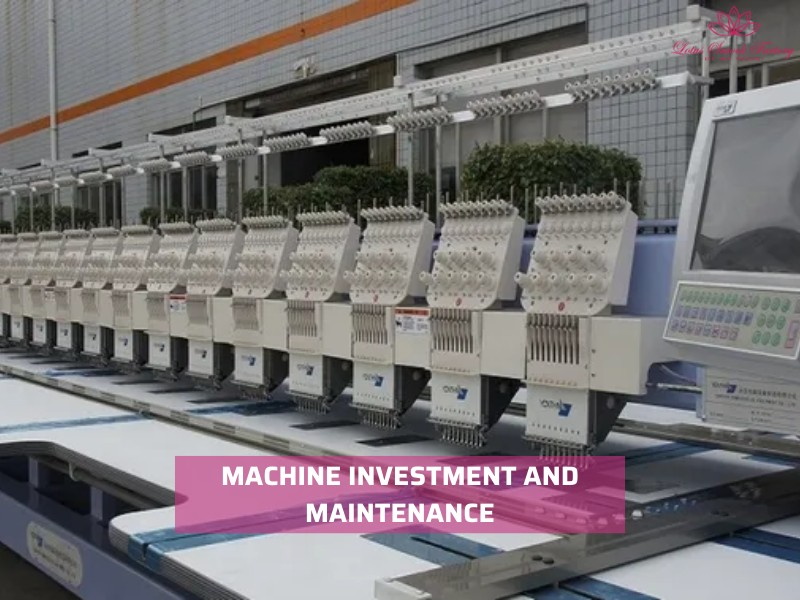
Several factors directly affect the embroidery business profit margin. From machine choice to pricing, each decision impacts how much money you earn from every order and how sustainable your embroidery business profit margin will be in the long run. Here are 5 key factors:
| Factor | Impact on Margin |
| Machine Investment |
|
| Material Costs | Buying thread, stabilizers, and blanks in bulk significantly lowers per-unit costs |
| Labor Efficiency |
|
| Pricing Strategy |
|
3.2. In-House Strategies
Regardless of your business size, these straightforward strategies directly improve your embroidery business profit margin:
- Focus on bulk orders: Large orders increase machine efficiency and reduce per-unit costs.
- Buy materials in bulk: Thread, stabilizers, and blanks cost significantly less when purchased wholesale.
- Target niche markets: Specialized markets like custom apparel, wedding gifts, or uniforms allow for higher pricing and stronger margins.
- Automate with multi-head machines: Multi-head machines increase output per hour, directly boosting revenue per labor hour.
- Offer personalization: Adding names, monograms, or logos justifies premium pricing and reduces competition from mass-produced alternatives.
3.3 Most Profitable Products for an Embroidery Business
The embroidery business profit margin varies by product type, choosing the right product mix is key to optimizing your embroidery business profit margin. Some items bring high margins because of low material costs, while others rely on bulk orders to make a steady income. Below are the products that often give the best returns for small embroidery businesses.
Profit Comparison Table
If you focus on high-margin products like patches, baby clothing, and gifts, your small embroidery businesses can achieve faster ROI while keeping production flexible.
| Product Type | Average Selling Price | Average Cost | Profit Margin Range | Notes |
| Custom Patches | $5–$10 | $1–$3 | 50%–65% | High demand, bulk orders easy to fill |
| Baby Clothes & Smocked Dresses | $40–$80 | $15–$30 | 55%–65% | Common boutique products |
| Corporate Uniforms | $20–$30 | $15–$22 | 20%–30% | Lower margin but steady volume |
| Caps and Hats | $15–$25 | $7–$12 | 40%–55% | Popular for teams and events |
| Home Décor & Gifts | $25–$50 | $10–$20 | 45%–60% | High-margin in seasonal or wedding markets |

3.4. Partner with Lotus Smock
A smarter option is to partner with Lotus Smock. It’s a trustworthy smocked clothing supplier known for delivering high-quality handmade seasonal holiday dresses and embroidered children’s clothing. Instead of investing in expensive equipment and labour, boutiques can resell ready-to-wear smocked outfits with high resale margins.
Here’s why boutiques worldwide choose Lotus Smock:
Low Minimum Order Quantity (MOQ)
You don’t need to commit to large batches. Start with just 30 pieces per style, covering sizes from 3M to 6Y. This flexibility lets you test new designs without high risk.
High Resale Margins
Handmade embroidery has strong customer appeal, especially for seasonal outfits like handmade Christmas dresses or Easter smocked clothing. Parents are willing to pay premium prices, so boutiques enjoy higher profit margins compared to mass-produced baby clothes.
Customization Options
Boutiques can request monograms, adjust thread colors, or add holiday motifs such as reindeer, bunnies, or hearts. These personalization options make collections exclusive, boosting brand value.
Fast Production and Shipping
Lotus Smock offers reliable timelines: 30–35 working days for production and 5–7 days of FedEx shipping. You can plan around seasonal peaks like Christmas or Easter with confidence.
Heirloom Quality & Lower Return Rates
Each smocked dress is made by hand and hand-checked for stitching strength and colorfastness. Fabrics such as cotton voile and Swiss dot provide comfort and durability. Customers are more satisfied, which reduces returns and improves brand reputation.
Contact Lotus Smock to Start Your Order:
- Facebook: facebook.com/lotussmockfactory
- WhatsApp: +84 83 333 3498
- Youtube: youtube.com/@LotusSmockFactory

4. FAQs
Running an embroidery business often involves challenges from machine costs, pricing models to supplier partnerships that directly affect your embroidery business profit margin. Below are the most frequently asked questions boutique owners and new embroidery businesses ask.
Q1: What is the average embroidery business profit margin?
Most embroidery businesses report margins between 20% and 60% depending on the product and pricing model. Higher-end items like boutique baby clothes or personalized gifts can reach 50%–65%, while bulk uniform orders usually sit at the lower end.
Q2: How much can a home-based embroidery business earn per month?
A home-based embroidery business can earn anywhere from USD 500 to USD 5,000+ per month. Earnings depend on machine capacity, hours worked, and whether you target small retail orders, custom gifts, or bulk clients.
Q3: What embroidery products give the highest margins?
Products with the best margins include:
- Custom patches: low material cost, high demand.
- Baby clothes and smocked dresses: boutique appeal, strong markup.
- Caps and hats: fast production, good resale value.
Q4: How long does it take to break even on an embroidery machine?
On average, small businesses recover their investment in 12–24 months. A basic single-needle machine costs around USD 800–1,500, while a commercial multi-needle machine can cost USD 8,000–12,000. The exact payback period depends on your order volume and profit margins.
5. Final Words
The embroidery business profit margin depends on smart cost control, efficient machines, and the right pricing model. While most businesses work within the 20%–60% range, you can raise your embroidery business profit margin higher by focusing on high-value products and wholesale supplies. If you want the rewards of embroidery without handling machines, supplies, and training, you can also partner with suppliers like Lotus Smock for ready-made embroidered clothing with built-in profit potential. Start reviewing your costs and products today so you can set prices that grow your embroidery profits with confidence.